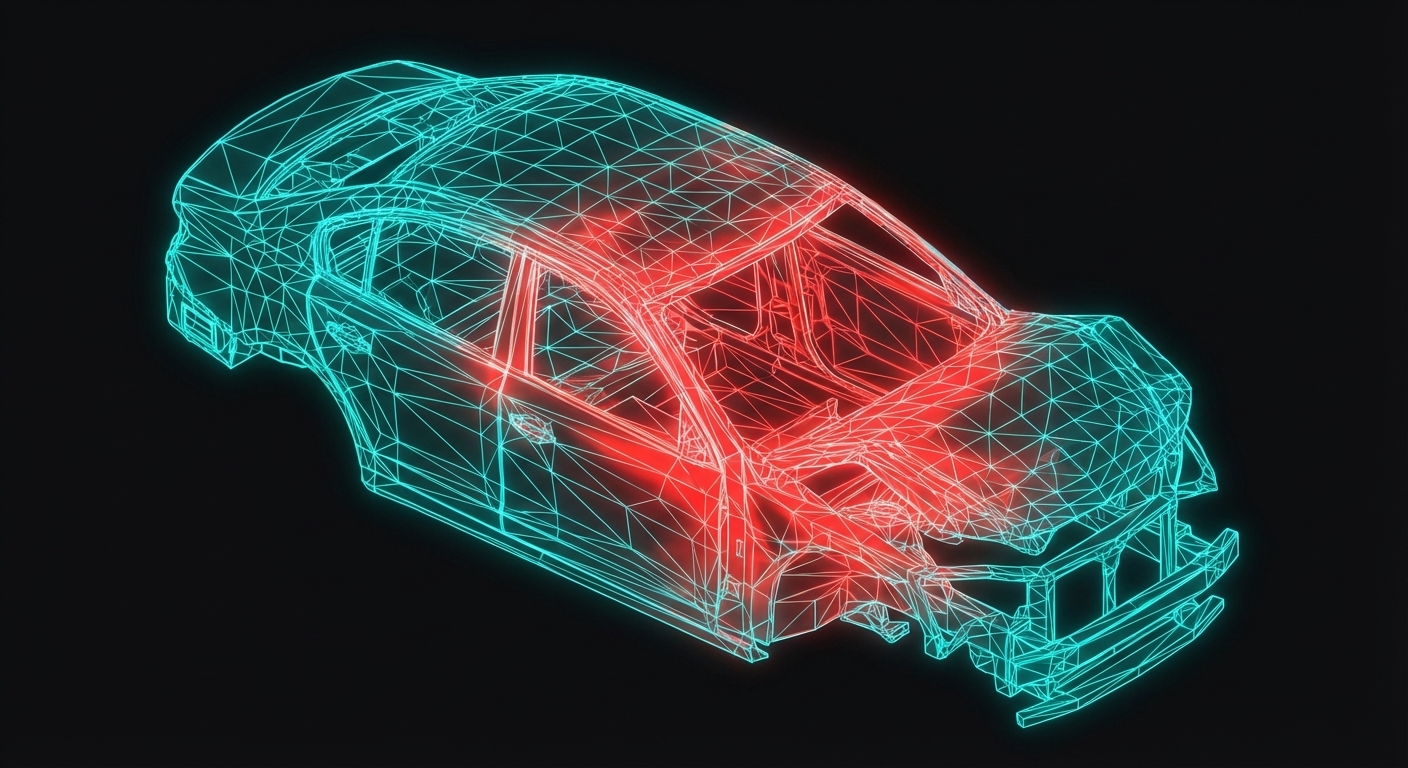
The mesh is where mathematics meets geometry. A CFD solver can only be as good as its mesh — garbage in, garbage out. This lesson covers the art and science of creating meshes that give accurate, reliable results.
Why Meshing Matters
Consider solving the Navier-Stokes equations on a mesh:
Mesh Quality
Consequence
Too coarse
Misses flow features, large truncation error
Too fine
Excessive computation time, no accuracy gain
Poor quality
Convergence issues, spurious oscillations
Wrong type
Cannot capture physics (e.g., boundary layers)
Rule of thumb: 50-70% of CFD time is spent on meshing and geometry cleanup.
Mesh Types
Compare structured, unstructured, and hybrid meshes. Click to see characteristics of each type.
This gives a better estimate than any single mesh.
Practical Meshing Workflow
1. Geometry Preparation
Remove small features (< 0.1% of characteristic length)
Close gaps and overlaps
Create named surfaces for boundaries
Extract fluid volume
2. Size Field Definition
Global base size (characteristic length / 20-50)
Surface refinement on key features
Volume refinement in wake, shear layers
Proximity/curvature refinement
3. Boundary Layer Creation
Identify walls needing boundary layers
Calculate y+ requirements
Set inflation parameters
Check for intersection with geometry
4. Volume Mesh Generation
Choose algorithm (Delaunay, advancing front)
Set quality thresholds
Generate and check initial mesh
Improve problem areas
5. Quality Check
Maximum skewness < 0.9
Mean skewness < 0.3
Orthogonality > 0.1 (minimum)
No negative volumes
Smooth size transitions
Software-Specific Tips
ANSYS Meshing
Use Proximity and Curvature for automatic sizing
Inflation method: First Layer Thickness preferred
Assembly meshing for multi-body geometries
STAR-CCM+
Polyhedral meshes often superior to tetrahedral
Trimmed cell mesher for external aero
Prism layer mesher for boundary layers
OpenFOAM (snappyHexMesh)
Octree-based background mesh
Surface snapping for conformity
Layer addition for boundary layers
Requires good STL surface quality
Common Meshing Mistakes
Mistake
Symptom
Solution
Missing refinement
Results don't match experiment
Add refinement in critical regions
No boundary layer mesh
Underpredicted drag, wall heat flux
Add inflation layers
High skewness
Non-convergence, oscillations
Improve mesh quality
Sudden size change
Spurious reflections
Smooth size transitions
Wrong y+
Incorrect wall shear stress
Recalculate first cell height
Key Takeaways
Mesh type matters: Structured for simple flows, hybrid for complex geometries
Quality metrics: Skewness < 0.9, aspect ratio depends on flow direction
Boundary layers: Critical for wall-bounded flows, y+ determines cell size
Mesh independence: Always perform grid convergence study
70% rule: Most CFD time is geometry and meshing — invest it wisely
Balance: Fine enough for accuracy, coarse enough for reasonable compute time
What's Next
With the mesh created, we need to specify what happens at the boundaries. The next lesson covers Boundary Conditions — inlets, outlets, walls, and symmetry — and how they're implemented numerically.
Career Growth
3,000+ Engineers Placed in Top Companies
Join the ranks of successful engineers at Bosch, Tata, L&T, and 500+ hiring partners.