Turbulence Modeling
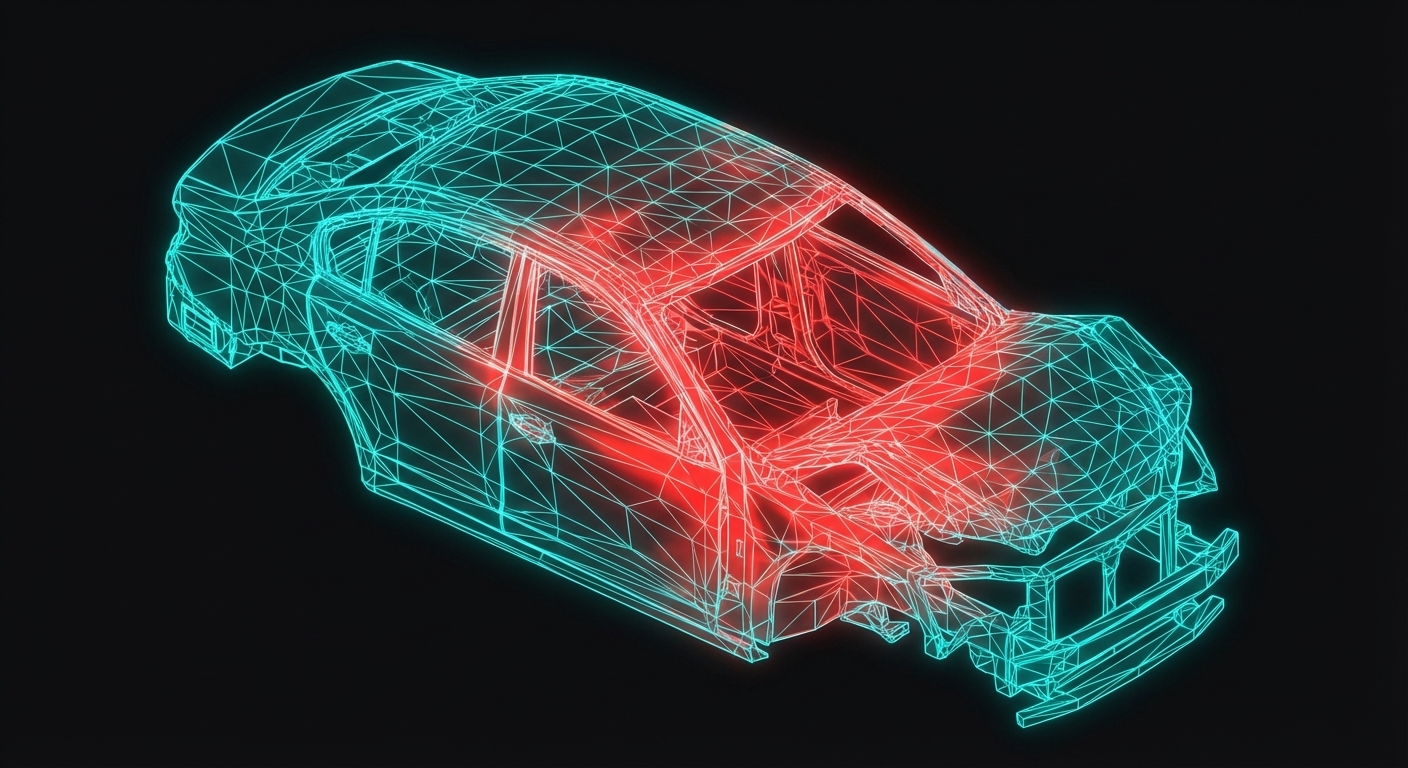
Turbulence is the dominant flow regime in engineering applications. When you drive a car at highway speeds, the Reynolds number based on vehicle length exceeds $10^6$ — firmly in the turbulent regime. Yet turbulence remains one of physics' greatest unsolved problems. CFD must model turbulence because directly resolving it is computationally prohibitive.
What Is Turbulence?
Characteristics
Turbulent flow exhibits:
Irregularity — Chaotic, seemingly random fluctuationsThree-dimensionality — Even in nominally 2D geometriesDiffusivity — Enhanced mixing of momentum, heat, and speciesDissipation — Kinetic energy cascades to small scales and dissipatesWide range of scales — From domain size to Kolmogorov microscaleThe Scale Separation Problem
The Kolmogorov length scale (smallest turbulent eddies):
Sponsored
3,000+ engineers placed at Mahindra, Bosch, TATA ELXSI
Including Continental, Capgemini, Ola Electric & 500+ more companies
$$\eta = \left(\frac{\nu^3}{\epsilon}\right)^{1/4}$$
The ratio of largest to smallest scales:
$$\frac{L}{\eta} \sim Re^{3/4}$$
Sponsored
Harshal got placed at Fiat Chrysler as Design Engineer
Watch his video testimonial on how the program helped him
For $Re = 10^6$ (typical car):
$L/\eta \sim 30,000$
3D mesh requirement: $(30,000)^3 \sim 10^{13}$ cells
Time steps: Proportional to smallest scales
Direct Numerical Simulation (DNS) resolves all scales but is limited to $Re \sim 10^4$ on supercomputers.
Reynolds Averaging
Visualize how velocity is decomposed into mean and fluctuating components. Decomposition
Every turbulent quantity can be split:
$$u = \bar{u} + u'$$
Sponsored
Srinithin now works at Xitadel as Design Engineer
Mechanical engineering graduate turned automotive designer
Where:
$\bar{u}$ = time-averaged (mean) velocity
$u'$ = fluctuating component
By definition: $\overline{u'} = 0$
Reynolds-Averaged Navier-Stokes (RANS)
Applying Reynolds averaging to the Navier-Stokes equations:
$$\frac{\partial \bar{u}_i}{\partial t} + \bar{u}_j \frac{\partial \bar{u}_i}{\partial x_j} = -\frac{1}{\rho}\frac{\partial \bar{p}}{\partial x_i} + \nu \frac{\partial^2 \bar{u}_i}{\partial x_j^2} - \frac{\partial \overline{u'_i u'_j}}{\partial x_j}$$
The last term is the Reynolds stress tensor :
$$\tau_{ij}^{turb} = -\rho \overline{u'_i u'_j}$$
The Closure Problem
We have 4 equations (continuity + 3 momentum) but introduced 6 new unknowns (symmetric Reynolds stress tensor). This is the turbulence closure problem — we need additional equations or assumptions.
The Boussinesq Hypothesis
Most RANS models assume the Reynolds stresses are proportional to mean strain:
$$-\overline{u'_i u'_j} = \nu_t \left( \frac{\partial \bar{u}_i}{\partial x_j} + \frac{\partial \bar{u}_j}{\partial x_i} \right) - \frac{2}{3}k\delta_{ij}$$
Where:
$\nu_t$ = turbulent (eddy) viscosity
$k = \frac{1}{2}\overline{u'_i u'_i}$ = turbulent kinetic energy
The task becomes: Model $\nu_t$ in terms of computable quantities.
Two-Equation Models
Why Two Equations?
Dimensional analysis suggests:
$$\nu_t \propto \text{velocity scale} \times \text{length scale}$$
Two equations provide two independent scales to determine $\nu_t$.
The k-epsilon Model
Transport equations for:
$k$ = turbulent kinetic energy
$\epsilon$ = dissipation rate of $k$
Turbulent viscosity:
$$\nu_t = C_\mu \frac{k^2}{\epsilon}$$
k equation:
$$\frac{\partial k}{\partial t} + \bar{u}_j \frac{\partial k}{\partial x_j} = \frac{\partial}{\partial x_j}\left[\left(\nu + \frac{\nu_t}{\sigma_k}\right)\frac{\partial k}{\partial x_j}\right] + P_k - \epsilon$$
epsilon equation:
$$\frac{\partial \epsilon}{\partial t} + \bar{u}_j \frac{\partial \epsilon}{\partial x_j} = \frac{\partial}{\partial x_j}\left[\left(\nu + \frac{\nu_t}{\sigma_\epsilon}\right)\frac{\partial \epsilon}{\partial x_j}\right] + C_{\epsilon 1}\frac{\epsilon}{k}P_k - C_{\epsilon 2}\frac{\epsilon^2}{k}$$
Production term:
$$P_k = \nu_t \left( \frac{\partial \bar{u}_i}{\partial x_j} + \frac{\partial \bar{u}_j}{\partial x_i} \right) \frac{\partial \bar{u}_i}{\partial x_j}$$
Standard constants:
Constant Value $C_\mu$ 0.09 $C_{\epsilon 1}$ 1.44 $C_{\epsilon 2}$ 1.92 $\sigma_k$ 1.0 $\sigma_\epsilon$ 1.3
k-epsilon Variants
Variant Feature Use Case Standard Original model Free shear flows RNG Renormalization group constants Wider range of flows Realizable Ensures positive normal stresses Flows with rotation
Limitations of k-epsilon
Poor near-wall performance — Requires wall functionsOverpredicts spreading rates in round jetsFails for strongly separated flows Insensitive to adverse pressure gradients The k-omega Family
k-omega Model (Wilcox)
Uses specific dissipation rate $\omega = \epsilon / (C_\mu k)$:
$$\nu_t = \frac{k}{\omega}$$
Advantages:
Better near-wall behavior
No wall functions needed (integrates to wall)
Good for boundary layers with pressure gradients
Disadvantage:
Sensitive to freestream $\omega$ values
k-omega SST (Shear Stress Transport)
Menter's SST model blends k-epsilon in the freestream with k-omega near walls:
$$F_1 = \tanh\left[\left(\min\left[\max\left(\frac{\sqrt{k}}{\beta^* \omega y}, \frac{500\nu}{y^2 \omega}\right), \frac{4\rho \sigma_{\omega 2} k}{CD_{k\omega}y^2}\right]\right)^4\right]$$
Blending:
$$\phi = F_1 \phi_1 + (1 - F_1)\phi_2$$
Where $\phi_1$ = k-omega constants, $\phi_2$ = transformed k-epsilon constants.
SST limiter for $\nu_t$:
$$\nu_t = \frac{a_1 k}{\max(a_1 \omega, S F_2)}$$
This prevents overprediction of shear stress in adverse pressure gradient flows.
Model Comparison
Compare performance of different turbulence models across flow types. When to Use What
Flow Type Recommended Model External aerodynamics k-omega SST Internal pipe flow k-epsilon (any variant) Heat transfer k-omega SST Combustion Realizable k-epsilon Rotating machinery SST with curvature correction Jets and mixing Standard k-epsilon Boundary layer separation k-omega SST
Model Hierarchy
Level Approach Description Cost 0 Algebraic Mixing length, zero-equation Very low 1 One-equation Spalart-Allmaras Low 2 Two-equation k-epsilon, k-omega Moderate 3 Reynolds Stress Full RSM High 4 LES Large Eddy Simulation Very high 5 DNS Direct Numerical Simulation Extreme
One-Equation Models
Spalart-Allmaras
Solves one transport equation for modified turbulent viscosity $\tilde{\nu}$:
$$\frac{D\tilde{\nu}}{Dt} = c_{b1}\tilde{S}\tilde{\nu} - c_{w1}f_w\left(\frac{\tilde{\nu}}{d}\right)^2 + \frac{1}{\sigma}\left[\nabla \cdot ((\nu + \tilde{\nu})\nabla\tilde{\nu}) + c_{b2}(\nabla\tilde{\nu})^2\right]$$
Designed for: Aerospace external flows
Advantages:
Simple (one equation)
Good for attached boundary layers
Widely validated for aerospace
Disadvantages:
Not general-purpose
Poor for free shear flows
Reynolds Stress Models (RSM)
Instead of assuming Boussinesq, solve transport equations for all six Reynolds stresses:
$$\frac{\partial \overline{u'_i u'_j}}{\partial t} + ... = P_{ij} + D_{ij} + \Pi_{ij} - \epsilon_{ij}$$
Advantages:
Captures anisotropy
Better for swirling, rotating flows
More physics
Disadvantages:
7 additional equations
More expensive
Harder to converge
Requires careful setup
Large Eddy Simulation (LES)
Philosophy
Resolve large, energy-containing eddies directly; model only small, universal scales.
Filtering
Apply spatial filter to Navier-Stokes:
$$\bar{u}_i(\mathbf{x}, t) = \int G(\mathbf{x} - \mathbf{x}', \Delta) u_i(\mathbf{x}', t) d\mathbf{x}'$$
Subgrid-Scale Models
The unresolved scales appear as subgrid-scale stress :
$$\tau_{ij}^{sgs} = \overline{u_i u_j} - \bar{u}_i \bar{u}_j$$
Smagorinsky model:
$$\nu_{sgs} = (C_s \Delta)^2 |\bar{S}|$$
LES Requirements
Requirement Implication 3D, transient Always unsteady simulation Fine mesh 80% of turbulent energy resolved Small time steps CFL ~ 1 Long run times Statistical averaging needed Inlet turbulence Synthetic generation required
LES is 100-1000x more expensive than RANS but provides:
Turbulent spectra
Instantaneous flow features
Better accuracy for separated flows
Wall Treatment
The Near-Wall Challenge
Turbulent boundary layers have distinct regions:
Viscous sublayer (y+ < 5): Viscosity dominatesBuffer layer (5 < y+ < 30): TransitionLog layer (y+ > 30): Universal log law$$y^+ = \frac{y u_\tau}{\nu}, \quad u_\tau = \sqrt{\tau_w / \rho}$$
Wall Functions
Concept: Don't resolve viscous sublayer; bridge with logarithmic profile.
$$u^+ = \frac{1}{\kappa}\ln(y^+) + B$$
Requirements:
First cell centroid at y+ = 30-300
Faster computation
Less accurate for separated flows
Low-Reynolds-Number Models
Concept: Resolve viscous sublayer directly.
Requirements:
First cell at y+ < 1
Many cells in boundary layer
More accurate but expensive
y+ Guidelines
Approach First Cell y+ Mesh Requirement Wall functions 30-300 Moderate Low-Re models < 1 Very fine near wall k-omega SST < 1 (preferred) Fine near wall
Practical Tips
Model Selection Flowchart
- Yes → k-epsilon probably fine
- No → Use k-omega SST
Strong rotation/curvature? Validation data available? Common Mistakes
Mistake Consequence Wrong y+ Incorrect wall shear, separation Default constants May not suit your flow No sensitivity study Overconfidence in results k-epsilon for separation Underpredicted separation Coarse mesh for SST Poor gradients, bad results
Turbulence Intensity
At inlet, specify turbulence based on upstream conditions:
Low turbulence (wind tunnel): $I = 0.5-1\%$
Medium (pipes, ducts): $I = 1-5\%$
High (after obstructions): $I = 5-20\%$
$$k = \frac{3}{2}(U \cdot I)^2$$
Key Takeaways
Turbulence is chaotic with wide scale ranges — DNS impractical for engineeringReynolds averaging introduces Reynolds stresses — the closure problemBoussinesq hypothesis models Reynolds stresses with eddy viscosityk-epsilon is robust for free shear flows; poor for separationk-omega SST is the workhorse for external aerodynamics and separated flowsWall treatment (y+) is critical for accurate resultsLES resolves large eddies directly — expensive but more accurateModel selection depends on flow physics and available resourcesWhat's Next
Turbulence models introduce approximations, and so does every other aspect of CFD. The next lesson covers Verification & Validation — how to quantify numerical errors and build confidence in your results.