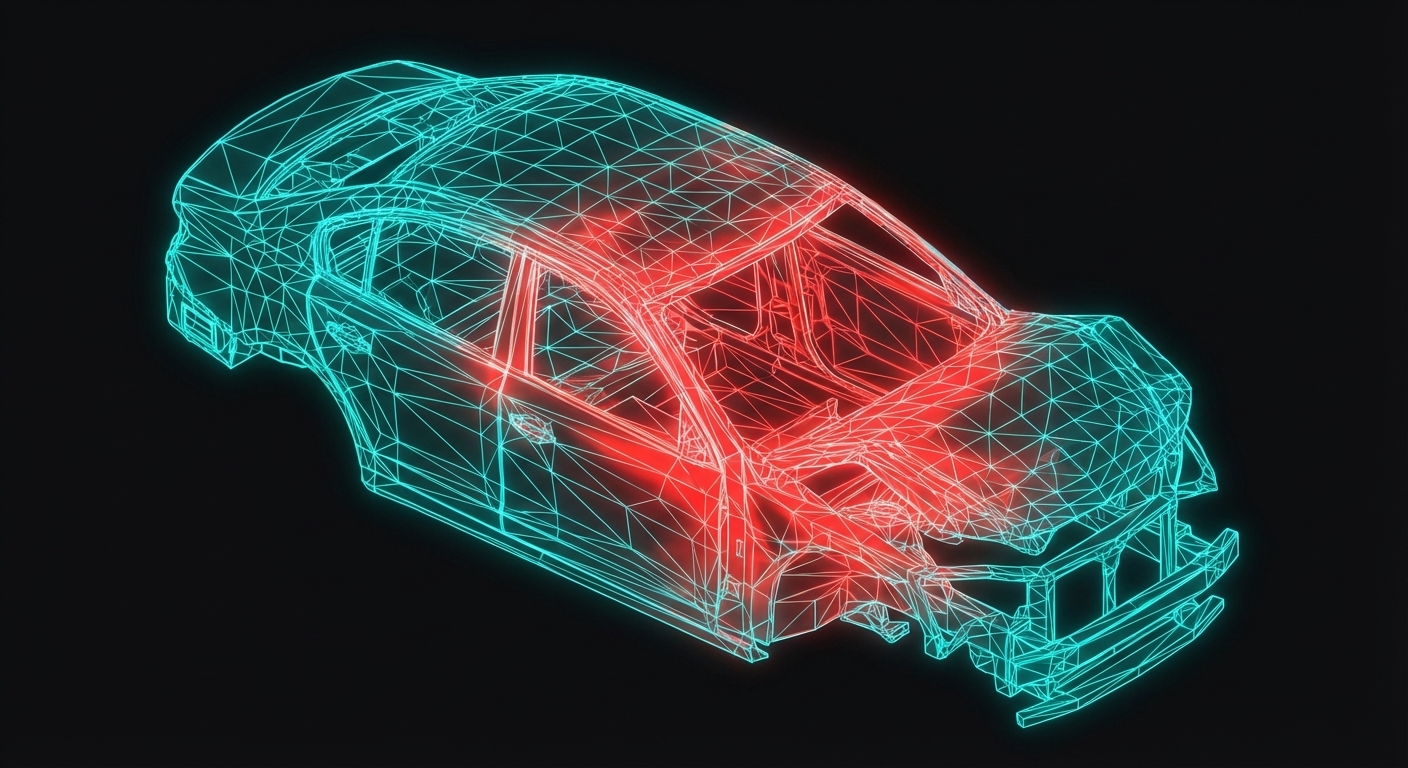
A composite is a material made from two or more constituents with significantly different properties that, when combined, produce a material with characteristics different from the individual components. In engineering, this almost always means strong, stiff fibers embedded in a polymer, metal, or ceramic matrix.
Composites are the fastest-growing structural material class in both aerospace and automotive. The Boeing 787 is 50% composite by weight. The BMW i3 has a full CFRP passenger cell. The reason is simple: composites offer the highest specific strength and specific stiffness of any structural material.
Why Composites?
The fundamental advantage is anisotropy by design — you place strong fibers exactly where the loads go. A unidirectional CFRP tape has a tensile strength of ~2,000 MPa along the fiber direction at a density of 1.55 g/cm³. No metal comes close to this specific strength.
Sponsored
3,000+ engineers placed at top companies in 2024
Mahindra, Bosch, TATA ELXSI, Capgemini and more
See Placement Stats
Property
CFRP (Quasi-iso)
Al 7075-T6
Ti-6Al-4V
Steel
Density (g/cm³)
1.55
2.81
4.43
7.85
σu (MPa)
~800
~570
~950
~500
E (GPa)
~70–150
~70
~110
~200
Specific strength (kN·m/kg)
~516
~203
~214
~64
Specific stiffness (MN·m/kg)
~45–97
~25
~25
~25
Fiber Types
Carbon Fiber
The dominant high-performance reinforcement. Made by pyrolysis of polyacrylonitrile (PAN) precursor at 1,000–3,000°C.
Type
Tensile Strength (GPa)
Modulus (GPa)
Strain to Failure (%)
Cost (USD/kg)
Use
Standard modulus (T300, T700)
3.5–5.0
230–240
1.5–2.0
~20–30
General aerospace & automotive
Intermediate modulus (T800, IM7)
5.5–6.0
290–300
1.8–2.0
~50–80
Primary aerospace structures
High modulus (M55, M60)
3.5–4.0
540–590
0.7
~100+
Space structures, satellites
T700 (Toray) is the workhorse for automotive and wind energy. IM7 (Hexcel) is the standard for military aerospace. T800 is used in the Boeing 787 wing and fuselage.
Glass Fiber
10–20× cheaper than carbon fiber. Lower strength and stiffness but excellent impact resistance and electrical insulation.
GFRP dominates by volume: wind turbine blades, boat hulls, truck body panels, automotive leaf springs (Volvo, GM). The Corvette C8 uses GFRP body panels.
Sponsored
Harshal got placed at Fiat Chrysler as Design Engineer
Watch his video testimonial on how the program helped him
See His Journey
Aramid (Kevlar)
Aramid fibers (Kevlar 29, Kevlar 49) offer exceptional impact and abrasion resistance at low density (1.44 g/cm³). Poor in compression — not used for primary structure. Used in ballistic protection, helicopter blade erosion strips, and honeycomb cores.
Other Fibers
Basalt fiber — Similar to E-glass but better chemical and temperature resistance. Emerging for automotive and infrastructure.
Ultra-high-molecular-weight polyethylene (UHMWPE / Dyneema) — Highest specific strength of any fiber. Used in body armor and marine ropes. Poor at elevated temperatures (melts at ~150°C).
Matrix Systems
The matrix binds the fibers, transfers loads between them, and protects them from the environment.
Thermoset Matrices
Resin
Tg (°C)
Pros
Cons
Application
Epoxy
120–180
High strength, low shrinkage, good adhesion
Brittle, slow cure, moisture absorption
Aerospace prepreg (Hexcel 8552, Cycom 977-3)
Vinyl ester
100–150
Good toughness, chemical resistance
Lower Tg than epoxy
Marine, chemical tanks, wind blades
Polyester
70–120
Cheap, fast cure
Lower properties than epoxy/VE
Boats, bathtubs, automotive SMC
BMI (bismaleimide)
250–300
High-temp capability
Brittle, expensive
Military aerospace (F-22 skin)
Hexcel 8552 epoxy is the most widely used aerospace prepreg resin. Cycom 977-3 is used for out-of-autoclave processing.
Thermoplastic Matrices
Growing rapidly because they can be welded, are tougher, and have unlimited shelf life (no refrigeration needed).
Sponsored
Gaurav Jadhav is now a CAE Engineer
Practical projects and mock interviews made the difference
Automotive structural — glass-filled PA for brackets and cross-members
🎯3,000+ Engineers Placed
Sponsored
Harshal
Fiat Chrysler
Abhishek
TATA ELXSI
Srinithin
Xitadel
Ranjith
Core Automotive
Gaurav
Automotive Company
Bino
Design Firm
Aseem
EV Company
Puneet
Automotive Company
Vishal
EV Startup
More Success Stories
Layup and Orientation
Unidirectional (UD) Tape
All fibers aligned in one direction. Maximum properties along the fiber axis, minimum perpendicular to it. The building block of aerospace laminates.
Along fiber: σu ~2,000 MPa, E ~140 GPa
Perpendicular to fiber: σu ~50 MPa, E ~10 GPa
This extreme anisotropy is why layup design matters so much.
Common Layup Conventions
Plies are stacked at specific angles to distribute load capability:
0° — Carries axial (longitudinal) loads
90° — Carries transverse loads
±45° — Carries shear loads and provides torsional stiffness
Standard Quasi-Isotropic Layup
[0/±45/90]s — Equal proportions of 0°, +45°, -45°, and 90° plies. Approximates isotropic behavior in the plane. This is the conservative baseline — used when loads come from multiple directions or when design is preliminary.
Properties are roughly 1/4 to 1/3 of the unidirectional values.
Tailored Layups
Real aerospace structures are optimized: a wing skin might be 60% 0° plies (for bending), 30% ±45° (for torsion), and 10% 90° (minimum for handling transverse loads). This is where composites gain their efficiency advantage over metals — material goes where the loads are.
Ply drop-offs — Thickness is varied by terminating plies where less strength is needed, saving weight. Requires careful design to avoid delamination at ply drops.
Composite layup orientation [0/±45/90]s — fibers placed at specific angles to carry different load types. Hover plies for details.
Sandwich Structures
A thin, stiff face sheet bonded to a thick, lightweight core. This dramatically increases bending stiffness at minimal weight cost — the same principle as an I-beam.
Core Type
Density (kg/m³)
Shear Strength (MPa)
Application
Nomex honeycomb (aramid)
32–128
1.0–4.5
Aerospace control surfaces, fairings, radomes
Aluminum honeycomb
50–130
2.0–8.0
Helicopter floors, satellite panels
PMI foam (Rohacell)
32–110
0.8–3.5
Wind blades, racing car bodies
PVC foam (Divinycell)
40–250
0.5–3.0
Marine hulls, automotive roof panels
Doubling the core thickness increases bending stiffness by ~7× at only ~3% weight increase. This is why sandwich construction is so prevalent in aerospace secondary structures.
Sandwich structure cross-section — thin face sheets bonded to a lightweight honeycomb core. Hover layers for details.
Manufacturing Methods
Prepreg + Autoclave
Pre-impregnated fiber sheets (prepreg) are laid up in a mold, vacuum-bagged, and cured in an autoclave at ~180°C and 6–7 bar pressure. The gold standard for aerospace quality — low void content (<1%), consistent properties.
Used for: Boeing 787 fuselage and wings, Airbus A350 wing covers, F-35 skins.
Limitation: Autoclaves are expensive (2–20M USD), slow (4–8 hour cycles), and limit part size.
Out-of-Autoclave (OOA)
Modified prepregs that achieve low void content under vacuum-only pressure. Eliminates the autoclave bottleneck. Gaining rapid adoption.
Used for: Bombardier CSeries (Airbus A220) wing, business jet structures.
Resin Transfer Molding (RTM)
Dry fiber preform placed in a closed mold; resin injected under pressure. Good for complex shapes and medium volumes.
Robotic heads lay down prepreg tape or tow onto a mold surface. Enables large, complex structures with optimized fiber paths.
Used for: Boeing 787 fuselage barrels, Airbus A350 wing skins, F-35 structures.
Failure Modes in Composites
Unlike metals, which fail progressively through yielding and necking, composites can fail in multiple modes simultaneously:
Fiber breakage — Catastrophic in tension. The dominant failure mode for UD laminates loaded along fibers.
Matrix cracking — Cracks parallel to fibers in off-axis plies. First damage to occur, often at ~40% of ultimate load.
Delamination — Separation between plies. Driven by out-of-plane stresses, impact damage, or manufacturing defects. The most dangerous failure mode because it can be invisible on the surface.
Fiber microbuckling — Compressive failure where fibers buckle within the matrix. Composites are typically 40–60% weaker in compression than tension.
Barely Visible Impact Damage (BVID) — A 10-joule impact (tool drop) can cause internal delamination with no visible surface mark. This is why aerospace composites are designed to damage tolerance criteria: the structure must carry limit load with BVID present.
Aerospace Composite Applications
Boeing 787 Dreamliner — 50% composite by weight. CFRP fuselage (one-piece barrel sections via AFP), CFRP wings, CFRP empennage. Enabled a wider cabin, larger windows, and higher cabin pressure (6,000 ft equivalent vs. 8,000 ft for aluminum aircraft).
Airbus A350 XWB — 53% composite by weight. CFRP wing covers, fuselage panels, empennage. Uses resin-infusion for some wing components.
F-35 Lightning II — 35% composite by structure weight. BMI matrix for high-temperature skins near engine. CFRP for wing skins and fuselage panels.
Automotive Composite Applications
BMW i3/i7 — CFRP passenger cell (Life Module) manufactured by RTM. First mass-production CFRP car body.
Chevrolet Corvette — GFRP body panels since 1953 (the longest-running composite car body). C8 uses SMC and GFRP extensively.
Automotive leaf springs — GFRP replacing steel in some applications (Volvo XC90, GM trucks). Single composite spring replaces multi-leaf steel assembly, saving ~60% weight.
Carbon fiber wheels — Carbon Revolution supplies CF wheels for Ford GT, Ferrari, Porsche. ~40% lighter than equivalent aluminum wheels.
Metal Matrix Composites (MMC)
Metal matrices reinforced with ceramic particles or fibers:
MMC
Matrix
Reinforcement
Application
Al-SiC
Aluminum
SiC particles
Brake rotors (Porsche PCCB uses SiC in ceramic matrix, but Al-SiC exists for other brake applications)
Al-Al₂O₃
Aluminum
Alumina fibers
Cylinder liner inserts (Honda, Toyota)
Ti-SiC
Titanium
SiC fibers
Compressor bling (bladed ring) — research stage
Ceramic Matrix Composites (CMC)
SiC fibers in a SiC matrix (SiC/SiC). Operating temperature: up to 1,300°C — 200°C higher than nickel superalloys, at 1/3 the density. The next revolution in jet engine materials.
GE LEAP engine — SiC/SiC CMC turbine shrouds. Saved ~120 lb per engine, 1% fuel burn improvement.
GE9X engine — CMC combustor liners, HPT shrouds, and nozzle. Most extensive CMC use in any production engine.
Key Takeaways
Composites offer the highest specific strength and stiffness of any structural material class
Carbon fiber dominates high-performance applications; glass fiber dominates by volume
Layup orientation is critical — [0/±45/90]s is the quasi-isotropic baseline; tailored layups optimize for specific load paths
Sandwich structures dramatically increase bending stiffness at minimal weight cost
Delamination and BVID are the critical failure/damage concerns for composite structures
CMCs (SiC/SiC) are replacing nickel superalloys in the hottest parts of jet engines
Career Growth
3,000+ Engineers Placed in Top Companies
Join the ranks of successful engineers at Bosch, Tata, L&T, and 500+ hiring partners.