Cooling System Design
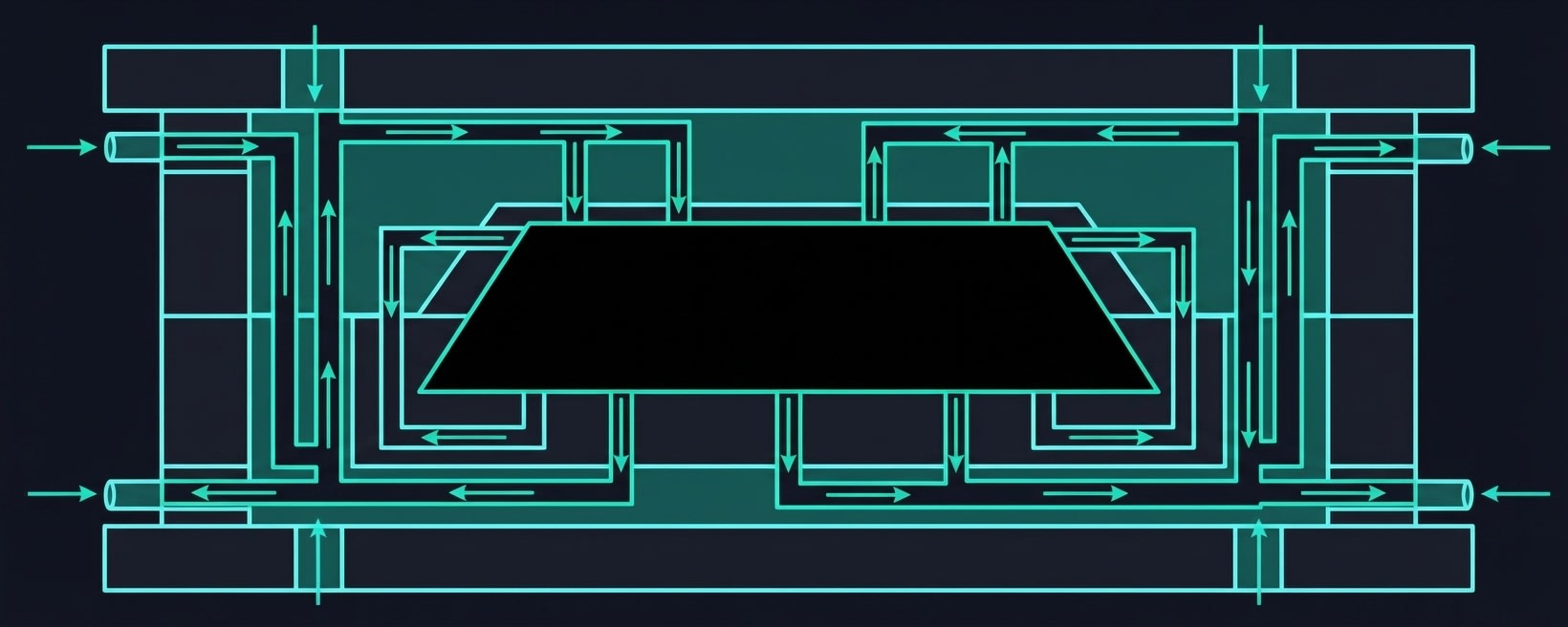
Why Cooling Matters
Cooling typically accounts for 60-80% of total cycle time. Effective cooling design directly impacts:
- Cycle time — Faster cooling = more parts per hour
- Part quality — Uniform cooling = less warpage
- Dimensional accuracy — Consistent shrinkage
- Surface finish — Proper solidification
The Math:
Cooling time scales with wall thickness squared:
t_cool ∝ t²
- 2 mm wall → ~8 seconds
- 4 mm wall → ~32 seconds
Heat Transfer Fundamentals
Heat flows from the molten plastic through the mold steel to the coolant:
Sponsored
Ranjith switched from IT to core automotive industry
His inspiring career transition story with video
Plastic → Mold Steel → Coolant
         (conduction)   (convection)
Limiting Factor: Usually conduction through steel, not convection to coolant.
Heat to Remove:
Q = m × Cp × ΔT + m × ΔH_f (for crystalline)
Where:
- m = mass of part
- Cp = specific heat
- ΔT = temperature drop
- ΔH_f = heat of fusion (crystalline materials)
Conventional Cooling Channels
Straight-drilled channels through mold plates:
Design Guidelines
| Parameter | Guideline |
|---|
| Diameter | 8-12 mm (6 mm min) |
| Spacing | 2-3× diameter |
| Distance to surface | 1.5-2× diameter |
| Circuit length | <1.5 m to limit ΔT |
Layout Patterns
Series Circuit:
- One inlet, one outlet
- Simple but uneven cooling
- Large ΔT along circuit
Parallel Circuit:
- Multiple channels fed simultaneously
- More uniform temperature
- Requires flow balancing
Auxiliary Cooling Methods
Baffles:
A blade dividing a drilled hole into two semi-circular channels:
Sponsored
Master CATIA, NX, LS-DYNA, HyperMesh, ANSYS
The exact tools used by Mahindra, Bosch & TATA ELXSI
- Coolant flows down one side, up the other
- Brings cooling closer to deep cores
Bubblers:
A tube inside a drilled hole:
- Coolant flows up the tube, down the annulus
- For tall cores where baffles don't fit
Beryllium Copper Inserts:
High thermal conductivity inserts for hot spots:
- BeCu: 100-200 W/m·K vs. steel: 25-50 W/m·K
- 2-4× better heat transfer
- Used in cores, corners, bosses
Conformal Cooling
Cooling channels that follow part geometry, enabled by additive manufacturing:
Sponsored
Srinithin now works at Xitadel as Design Engineer
Mechanical engineering graduate turned automotive designer
Advantages
| Metric | Conventional | Conformal |
|---|
| Cooling time | Baseline | 20-40% reduction |
| Temperature uniformity | ±10-20°C | ±2-5°C |
| Warpage | Higher | Significantly lower |
| Hot spots | Common | Eliminated |
Manufacturing Methods
- DMLS/SLM: Direct metal laser sintering (most common)
- Hybrid: Machined base + printed insert
- Vacuum brazing: Laminated plates with channels
Design Considerations
- Channel diameter: 3-6 mm (smaller than conventional)
- Can include organic shapes that follow part contours
- Self-supporting angles required (>45° from horizontal)
- Cost: 2-5× conventional tooling
When to Use Conformal Cooling
| Criteria | Conformal Recommended |
|---|
| Cycle time critical | Yes |
| Complex geometry | Yes |
| Warpage issues | Yes |
| Tool life >500k shots | Yes |
| Low-volume production | No (cost prohibitive) |
Cooling Time Calculation
Simplified Formula:
t_cool = (s²/π²α) × ln[(4/π) × (T_m - T_w)/(T_e - T_w)]
Where:
- s = wall thickness (mm)
- α = thermal diffusivity (mm²/s)
- T_m = melt temperature (°C)
- T_w = mold wall temperature (°C)
- T_e = ejection temperature (°C)
Typical Values:
| Material | α (mm²/s) | T_e (°C) |
|---|
| PP | 0.08 | 80-90 |
| ABS | 0.10 | 90-100 |
| PA66 | 0.12 | 120-140 |
| PC | 0.12 | 120-140 |
Coolant Selection
Water (Most Common)
- Temperature: 10-80°C
- Economical, high heat capacity
- Requires treatment to prevent scale/corrosion
Oil
- Temperature: 80-150°C
- For high mold temperatures (PC, PEEK)
- Lower heat capacity, more expensive
Chilled Water
- Temperature: 5-15°C
- Maximum cooling rate
- Risk of condensation if below dew point
Flow Requirements
Turbulent Flow Required:
Reynolds Number > 5,000 (ideally >10,000)
Flow Rate:
Re = (ρ × v × D) / μ
For 10mm channel with water at 25°C:
- Minimum velocity: ~0.5 m/s for turbulence
- Typical flow rate: 4-8 L/min per circuit
Temperature Control Units (TCU)
Specifications:
- Heating capacity: 6-24 kW typical
- Cooling capacity: Match heating
- Flow rate: 20-80 L/min
- Temperature stability: ±0.5°C
Maintenance:
- Clean filters monthly
- Flush circuits quarterly
- Check flow rates regularly
Common Cooling Problems
| Problem | Symptom | Solution |
|---|
| Inadequate flow | Long cycles | Increase pump capacity |
| Scale buildup | Gradual cycle increase | Clean circuits, water treatment |
| Hot spots | Local warpage | Add BeCu, conformal, or baffles |
| Uneven cooling | Warpage, curl | Balance circuits, add channels |
Key Takeaways
- Cooling is 60-80% of cycle time; optimize it first
- Channel spacing: 2-3× diameter; depth: 1.5-2× diameter
- Use baffles and bubblers for deep cores
- Conformal cooling can reduce cycle time 20-40%
- Maintain turbulent flow (Re > 5,000) for heat transfer
- Regular maintenance prevents degradation
---
Next Lesson: Common Defects & Troubleshooting — identifying and fixing problems.