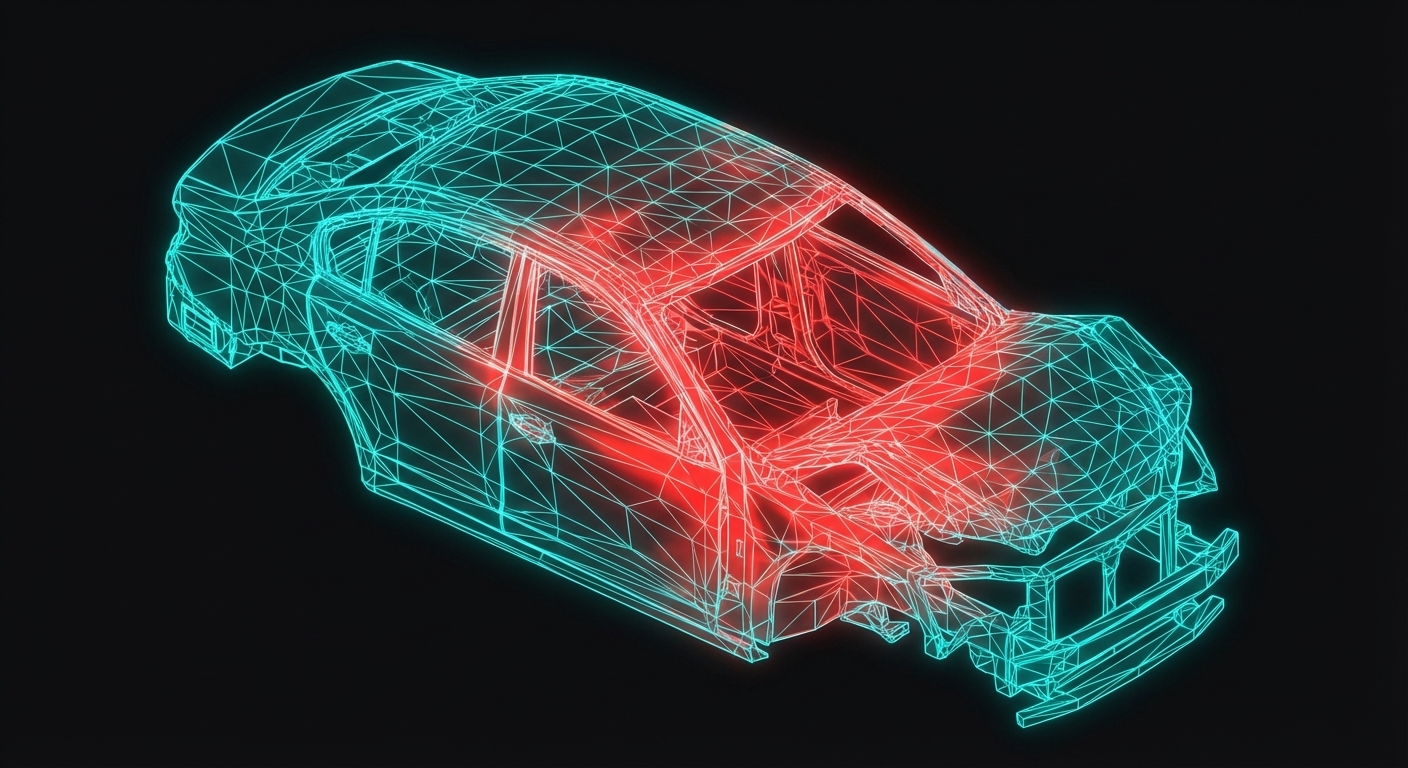
We've mastered 1D bar elements. Now we extend to 2D elements that can model plates, shells, and plane structures. The fundamental concepts remain the same — shape functions, B-matrix, stiffness matrix — but with more DOFs and richer behavior.
Plane Stress vs Plane Strain
Before diving into elements, we need to understand the two 2D approximations:
Plane Stress
Used for thin structures where stress through thickness is negligible:
Key observation: $[B]$ contains only constants (no $x$ or $y$). This means strain is constant throughout the element — hence "Constant Strain Triangle."
Stiffness Matrix
$$[K_e] = \int_A [B]^T [D] [B] \, t \, dA = [B]^T [D] [B] \cdot t \cdot A$$
Since $[B]$ is constant, the integral is trivial — just multiply by the area!
The result is a 6×6 symmetric matrix.
Limitations of CST
Constant strain can't capture strain gradients
Poor in bending — need many elements
Overly stiff behavior (locking)
Rule of thumb: Use CST only for membrane-dominated problems or as a learning tool. For real analysis, use higher-order elements.
🎯3,000+ Engineers Placed
Sponsored
Harshal
Fiat Chrysler
Abhishek
TATA ELXSI
Srinithin
Xitadel
Ranjith
Core Automotive
Gaurav
Automotive Company
Bino
Design Firm
Aseem
EV Company
Puneet
Automotive Company
Vishal
EV Startup
More Success Stories
The 6-Node Triangle (LST)
The Linear Strain Triangle (LST) adds mid-side nodes for quadratic shape functions:
6 nodes, 12 DOFs
Quadratic displacement field
Linear strain variation
$$N_1 = \xi(2\xi - 1)$$
$$N_2 = \eta(2\eta - 1)$$
$$N_3 = \zeta(2\zeta - 1)$$
$$N_4 = 4\xi\eta$$
$$N_5 = 4\eta\zeta$$
$$N_6 = 4\zeta\xi$$
Where $\xi$, $\eta$, $\zeta$ are area coordinates with $\xi + \eta + \zeta = 1$.
Advantages:
Much better accuracy than CST
Can capture bending behavior
Handles stress concentrations better
The 4-Node Quadrilateral (Q4)
Drag nodes to reshape the quad. Watch how shape functions vary across the element. Toggle Jacobian view.
The bilinear quadrilateral has 4 nodes at corners, 8 DOFs total.
Higher-order elements (LST, Q8) capture strain gradients better
Isoparametric mapping: Same shape functions for geometry and field
Jacobian: Relates natural to physical coordinates; must be positive
Mesh quality: Aspect ratio, skewness, and Jacobian affect accuracy
Assembly: Same scatter operation, but with 2 DOFs per node
What's Next
The stiffness matrix for Q4 and higher elements requires numerical integration because $[B]$ varies with position. We'll learn about Gauss quadrature — the standard method for evaluating these integrals efficiently and accurately.
Career Growth
3,000+ Engineers Placed in Top Companies
Join the ranks of successful engineers at Bosch, Tata, L&T, and 500+ hiring partners.