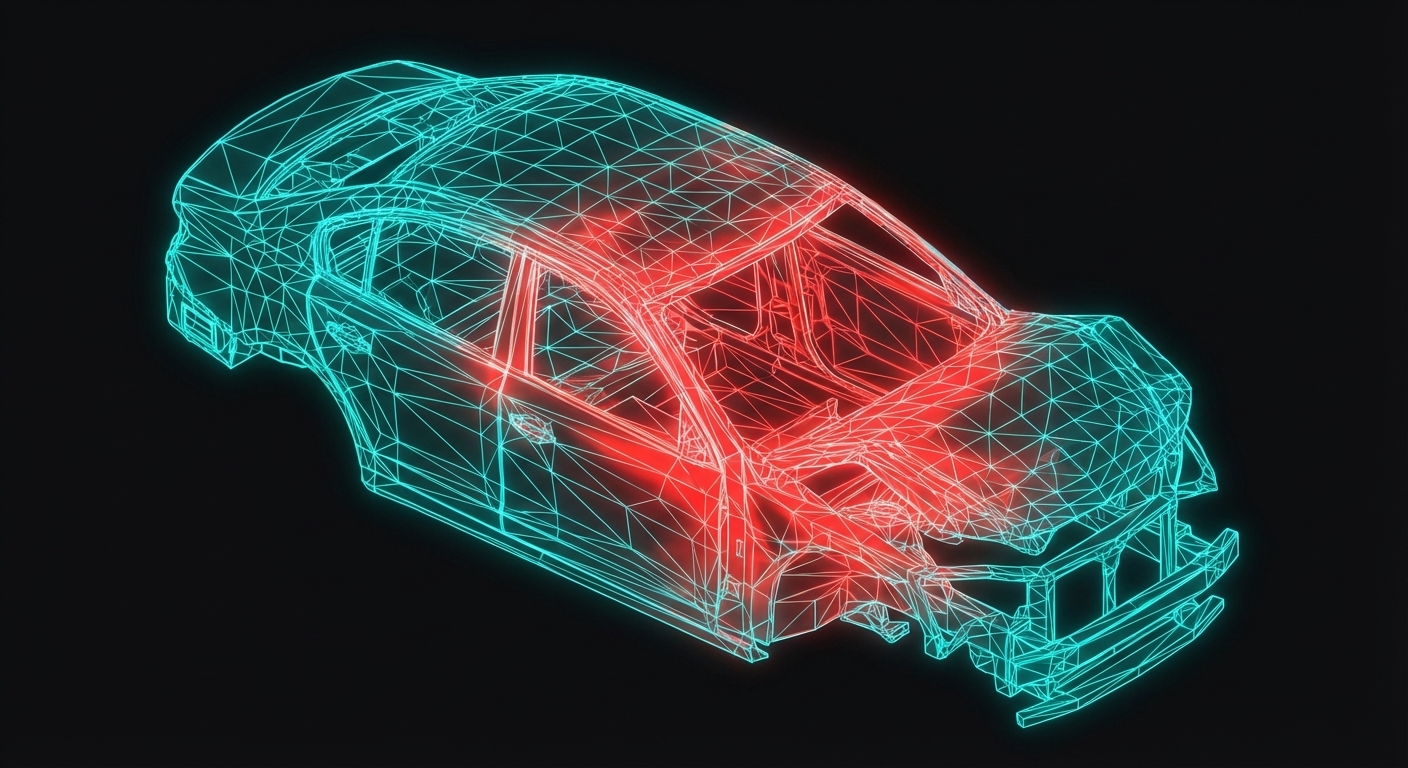
Every engineered product — from the chassis of a Tata Nexon to the landing legs of Chandrayaan-3 — must withstand real-world forces without failing. But how do engineers predict stress, deformation, and failure before building a single prototype?
The answer is Finite Element Analysis (FEA) — a numerical method that transforms complex engineering problems into solvable systems of equations.
The Core Problem: PDEs Are Hard
Engineering physics is governed by partial differential equations (PDEs). For structural mechanics, the equilibrium equation is:
Sponsored
April batch closing soon — only 42 seats remaining
Join 3,000+ engineers who got placed at top companies
This states that internal stresses must balance external forces at every point in a body. For simple geometries (beams, plates, cylinders), we can solve this analytically. But for a complex bracket, an engine block, or an aircraft wing? Analytical solutions don't exist.
Analytical methods work for simple shapes. FEA handles the real world. Toggle between geometries to see the difference.
Combine element stiffness matrices into the global system: [K]{u} = {F}
Solution:
Solve for nodal displacements {u}
For large models: Iterative solvers (Conjugate Gradient, GMRES)
For nonlinear: Newton-Raphson iterations
Stage 3: Postprocessing
Results extraction:
Compute strains from displacements: ε = [B]{u}
Compute stresses from strains: σ = [D]{ε}
Visualization:
Contour plots: Stress, displacement, temperature
Deformed shape (scaled for visibility)
Section cuts, iso-surfaces, animations
Validation:
Check reaction forces balance applied loads
Compare with analytical solutions (where available)
Perform mesh convergence study
🎯3,000+ Engineers Placed
Sponsored
Harshal
Fiat Chrysler
Abhishek
TATA ELXSI
Srinithin
Xitadel
Ranjith
Core Automotive
Gaurav
Automotive Company
Bino
Design Firm
Aseem
EV Company
Puneet
Automotive Company
Vishal
EV Startup
More Success Stories
Indian Industry Applications
FEA is everywhere in Indian engineering. Here are real-world applications:
Sponsored
Get up to ₹60,000 off with Founder's Scholarship
Only 42 seats left for the April batch
Check Eligibility
Automotive: TATA Motors
TATA uses FEA extensively for crashworthiness simulation. The Nexon achieved a 5-star GNCAP safety rating — a first for an Indian car. Before physical crash tests, engineers run thousands of virtual crashes:
Frontal impact: 64 km/h into deformable barrier
Side impact: 50 km/h pole impact
Roof crush: 3× vehicle weight
Each simulation predicts intrusion, accelerations, and injury metrics — allowing design iteration in software rather than steel.
Aerospace: ISRO
The PSLV rocket and Chandrayaan lander undergo rigorous FEA:
Vibration analysis: Predict natural frequencies to avoid resonance during launch
Thermal stress: Temperature swings from -150°C to +120°C in orbit
Landing impact: Chandrayaan-3's legs were designed to absorb impact on lunar surface
Power & Heavy Engineering: L&T
Larsen & Toubro uses FEA for:
Steam turbine blades: Centrifugal stress at 3000 RPM, creep at 550°C
Pressure vessels: ASME code compliance, fatigue life prediction
Structural steel: Bridge and plant structure analysis
The Mathematical Foundation (Preview)
FEA is built on solid mathematical principles. In the coming lessons, we'll cover:
Weak form: The integral formulation that makes FEA possible
Shape functions: How we approximate field variables within elements
Stiffness matrix: The relationship between nodal forces and displacements
Assembly: How element equations combine into the global system
Numerical integration: Computing integrals using Gauss quadrature
Each concept will have interactive visualizations so you can build intuition, not just memorize equations.
Software Landscape
Understanding the tools used in industry:
Software
Strengths
Usage in India
ANSYS
All-purpose, excellent documentation
Dominant in automotive, aerospace
HyperMesh
Best-in-class meshing
Standard preprocessor at OEMs
Abaqus
Nonlinear, contact, composites
Aerospace, research
NASTRAN
Linear structural, NVH
Automotive, established industries
LS-DYNA
Explicit dynamics, crash
Crash simulation
COMSOL
Multiphysics, easy coupling
Academia, R&D
For learning FEA fundamentals, the software doesn't matter — the concepts are universal. But for career preparation, ANSYS certification is valuable in the Indian market.
Key Takeaways
FEA is a numerical method to solve PDEs that have no analytical solution
The method discretizes continuous domains into elements, approximates physics within each, then assembles and solves a global system
The workflow is: Geometry → Mesh → BCs → Solve → Postprocess
FEA is critical in Indian industries: TATA (crash), ISRO (structural), L&T (thermal-structural)
This course teaches the mathematics — understanding "why" makes you a better engineer, not just a software operator
What's Next
In the next lesson, we'll dive into the mathematical foundations — specifically the transformation from strong form (differential equation) to weak form (integral equation). This is the key insight that makes FEA work.
Career Growth
3,000+ Engineers Placed in Top Companies
Join the ranks of successful engineers at Bosch, Tata, L&T, and 500+ hiring partners.