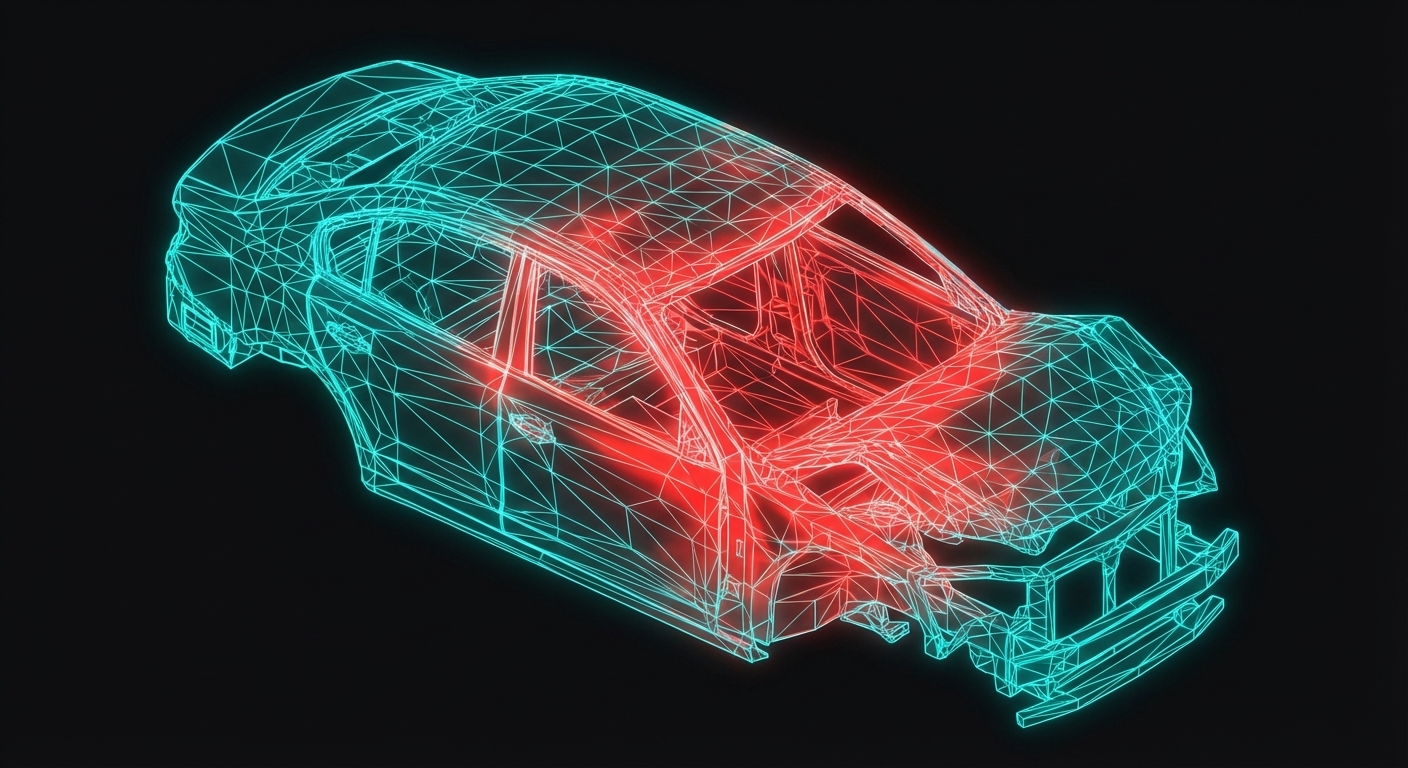
In the previous lesson, we saw that the weak form transforms a differential equation into an integral equation. But to solve it numerically, we need to discretize — break the continuous domain into manageable pieces. This is where nodes, elements, and shape functions come in.
Discretization: From Continuous to Discrete
A continuous domain has infinitely many points. We can't compute values at infinite points, so we:
Select key points called nodes where we'll compute the solution
Connect nodes to form elements — small regions where we'll approximate the physics
Interpolate the solution within each element using shape functions
Click on the bar to add nodes. Watch how elements form between adjacent nodes and DOFs are numbered.
Nodes: Where We Compute the Solution
Nodes are discrete points in the domain where:
The primary variable (displacement, temperature, etc.) is computed
Boundary conditions can be applied
Forces or fluxes can be specified
Each node has degrees of freedom (DOFs) — the unknown values we solve for:
Sponsored
Gaurav Jadhav is now a CAE Engineer
Practical projects and mock interviews made the difference
See His Journey
1D structural: 1 DOF per node (axial displacement $u$)
2D structural: 2 DOFs per node ($u_x$, $u_y$)
3D structural: 3 DOFs per node ($u_x$, $u_y$, $u_z$)
3D shell: 6 DOFs per node (3 translations + 3 rotations)
Node Numbering
Nodes are numbered sequentially. The numbering scheme affects:
Bandwidth of the stiffness matrix
Solver efficiency — good numbering reduces fill-in
Modern software auto-optimizes numbering (Cuthill-McKee, etc.)
Elements: Where Physics Happens
An element is a region bounded by nodes where we approximate the field variable. Elements are defined by:
Type: Bar, beam, triangle, quadrilateral, tetrahedron, hexahedron
Order: Linear (straight edges), quadratic (curved edges)
Connectivity: Which nodes belong to this element
1D Elements
Element
Nodes
Shape
Application
2-node bar
2
Linear
Truss members, axial loading
3-node bar
3
Quadratic
Higher accuracy, curved geometry
2-node beam
2
Cubic (Hermite)
Bending problems
2D Elements
Element
Nodes
Shape
Application
3-node triangle (CST)
3
Linear
Simple meshing, constant strain
6-node triangle (LST)
6
Quadratic
Better accuracy, curved edges
4-node quad (Q4)
4
Bilinear
Structured meshes
8-node quad (Q8)
8
Serendipity quadratic
Good all-around choice
3D Elements
Element
Nodes
Shape
Application
4-node tetrahedron
4
Linear
Auto-meshing complex geometry
10-node tetrahedron
10
Quadratic
Standard for accuracy
8-node hexahedron
8
Trilinear
Best accuracy/cost ratio
20-node hexahedron
20
Serendipity quadratic
High accuracy
🎯3,000+ Engineers Placed
Sponsored
Harshal
Fiat Chrysler
Abhishek
TATA ELXSI
Srinithin
Xitadel
Ranjith
Core Automotive
Gaurav
Automotive Company
Bino
Design Firm
Aseem
EV Company
Puneet
Automotive Company
Vishal
EV Startup
More Success Stories
Shape Functions: The Interpolation Magic
Shape functions (also called interpolation functions or basis functions) define how the field variable varies within an element.
For a 1D element with nodes at positions $x_1$ and $x_2$:
Sponsored
3,000+ engineers placed at Mahindra, Bosch, TATA ELXSI
Including Continental, Capgemini, Ola Electric & 500+ more companies
Physical meaning: At node $j$, only shape function $N_j$ is non-zero (and equals 1). This ensures nodal values are exactly recovered at node locations.
3. Completeness
Shape functions must be able to represent:
Rigid body motion (constant displacement)
Constant strain states
These are the minimum requirements for convergence.
4. Compatibility
At element boundaries, the field must be continuous. For $C^0$ continuity:
Displacement is continuous across elements
Strain may be discontinuous (acceptable for most problems)
Natural Coordinates
Instead of using physical coordinates $(x, y, z)$, we often use natural coordinates $(\xi, \eta, \zeta)$ that range from $-1$ to $+1$.
Hover over the parent element to see how points map to the physical element. Drag corner nodes to distort the physical element.Advantages:
Shape functions have the same form for all elements
Integration limits are always $-1$ to $+1$
Numerical integration (Gauss quadrature) is standardized
Key properties: Partition of unity, Kronecker delta, completeness, compatibility
Natural coordinates $(\xi, \eta)$ standardize element formulations
B-matrix relates nodal displacements to strains: $\varepsilon = [B]\{u\}$
Element choice matters: Linear elements are stiff in bending; use quadratic for accuracy
What's Next
Now that we understand shape functions and how they interpolate the field, we're ready to derive the element stiffness matrix — the key ingredient that relates nodal forces to nodal displacements.
Career Growth
3,000+ Engineers Placed in Top Companies
Join the ranks of successful engineers at Bosch, Tata, L&T, and 500+ hiring partners.